
CONTEXT FIRST
Use the journey, surrounding environment, and shared situation to make social interaction feel relevant rather than added on.
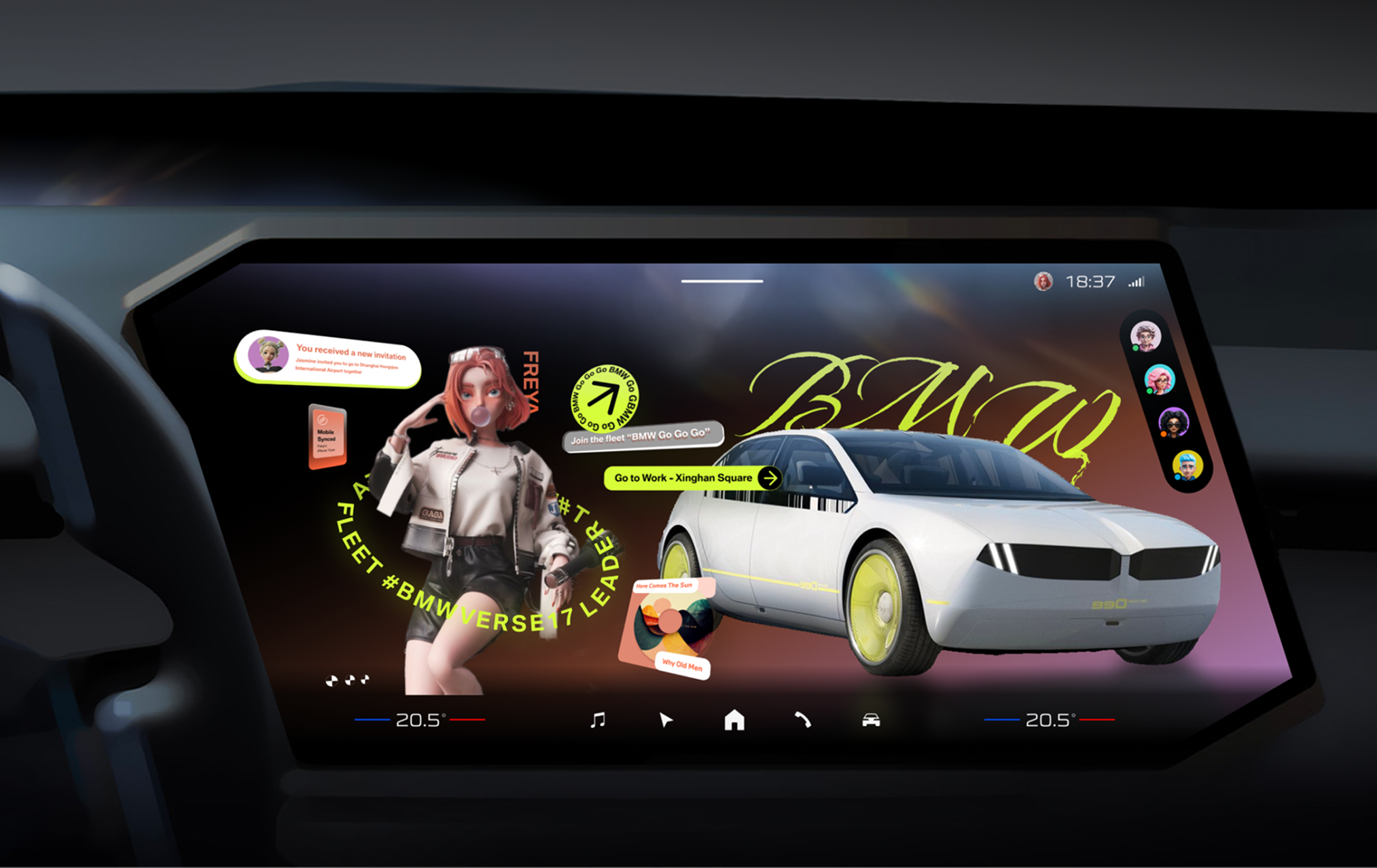
CONFIDENTIAL INDUSTRY PROJECT · BMW GROUP

OVERVIEW
A social experience concept for passengers in an L3 autonomous-driving context—exploring how mobility, place, and shared presence might create new ways of being together on the road.
A NOTE ON CONFIDENTIALITY
This project was developed during an industry internship and remains subject to confidentiality restrictions. Interface designs, internal research, product strategy, technical documentation, prototypes, and performance outcomes are intentionally omitted. This page shares only a high-level account of my role, process, and transferable design thinking.
THE DESIGN QUESTION
As driving becomes less demanding for passengers, the vehicle can support new forms of attention, entertainment, and connection. The opportunity was not simply to place a social network inside a car, but to rethink social interaction through the specific context of mobility.
The challenge was to balance novelty with calmness, shared experience with personal control, and an ambitious concept with the constraints of an automotive product and a real-time 3D implementation pipeline.
DESIGNING THE EXPERIENCE
Use the journey, surrounding environment, and shared situation to make social interaction feel relevant rather than added on.
Keep the experience glanceable and passenger-centered, with clear hierarchy and deliberate moments of attention.
Support connection and presence without reproducing the constant interruption patterns of a phone-based social feed.
Translate the concept into coherent flows, reusable states, and implementation-ready behavior for a real-time 3D environment.
FROM CONCEPT TO HANDOFF
Clarified the passenger context, design constraints, and the role a social layer could play inside an L3 autonomous journey.
Designed the information architecture and interaction flows, connecting entry points, social presence, and shared moments.
Built high-fidelity interactive prototypes to make timing, transitions, and system responses tangible for the wider team.
Refined the experience through product feedback, usability evaluation, and ongoing alignment with technical constraints.
WHAT I CARRY FORWARD
“In mobility, interaction design is not only about a screen—it is about attention, context, movement, and the people sharing the journey.”
Designed flows as part of a larger spatial and technical ecosystem.
Made interaction intent legible across product, design, and engineering.
Communicated the value of confidential work without exposing protected details.